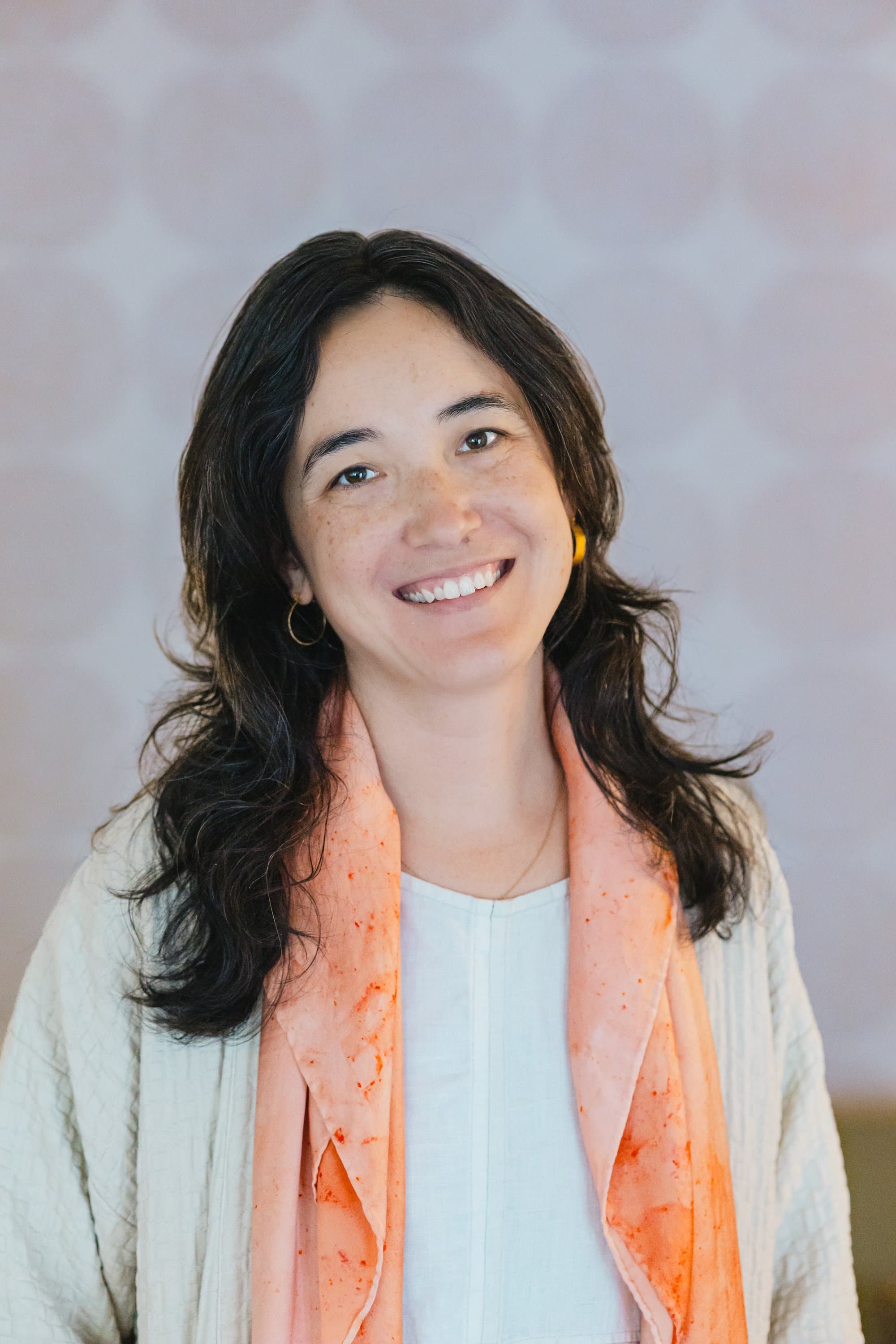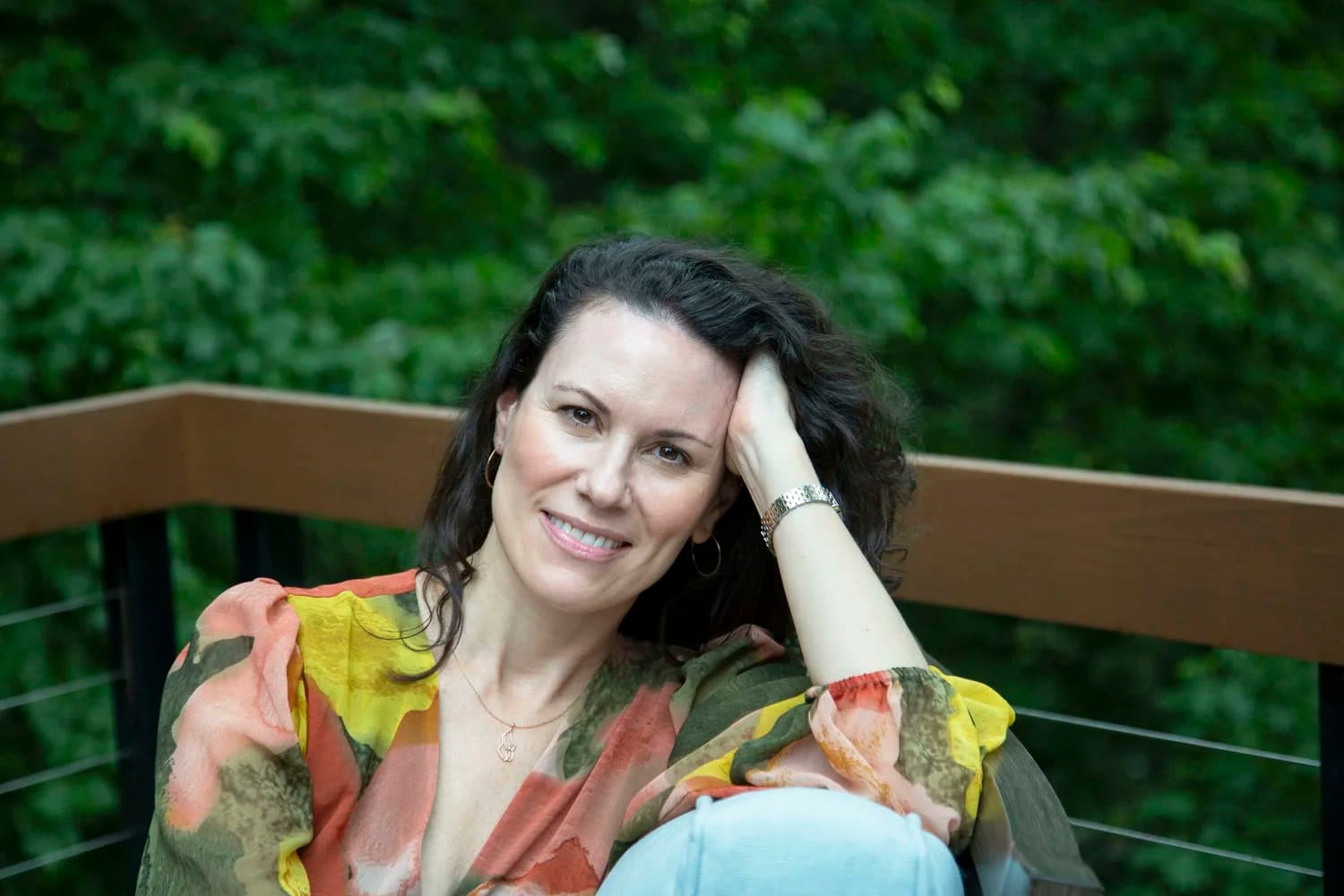
Jenna Hollenstein, MS, RD, CDN, is a dietitian, a meditation teacher, and the author of Mommysattva, Eat to Love, and Intuitive Eating for Life. Her work brings Buddhist teaching into the everyday practice of eating and living in a body. For five years she led the Open Heart Project's Mommy Sangha, a community of meditating mothers. We asked her about the path that led her away from diet culture, what mothers learn by sitting together, and where she begins with a new mother who wants to raise her child without it.
You've written that you were "a grown-up weirdo who never trusted my body or my own intelligence" until you got sober, quit dieting, and started meditating. What was the turning point that set you on the path toward becoming a dietitian who challenges diet culture instead of working inside it?
That's a little complicated. I believe that a lot of the motivation to become a dietitian came from unhealthy sources. The desire to know with certainty how to eat and move. The desire for control. It was only after another 15 years or so that I had a sort of breakthrough that the more control I sought, the less control I felt. There was some collision of sobriety, meditation, Buddhist wisdom, and maybe even a sneaking suspicion since I was quite young that there was more to having a body than controlling it. Once I began to see how I used alcohol, eating, dieting, and many other thought and behavior patterns to try to control my life, I leaned into what it might mean to let go of that intention. And as with all things that feel radical and liberating, I wanted to share it. I set about exploring the intersections between addiction, disordered eating, meditation and what it means to truly recover. To truly inhabit my body. To live with my senses and my heart open.
In Mommysattva you reframe motherhood through the Buddhist idea of the bodhisattva, a being who keeps showing up for others even as her own heart breaks open again and again. What made you want to name that particular shape of mothering, the Mommysattva, and give it to other women?
Ha! My husband always tells me that no one bought that book because no one understood the title. But I can't imagine naming it anything else. I think that mothers are initiated into being bodhisattvas almost automatically. Biologically, neurologically we are driven to ensure the wellbeing of our children. But, by extension, we start to see how everything is connected and that being of benefit to others, to the planet, to our communities all benefit our children. It's an expansive thing, becoming a mother. The highs and the lows are so much more extreme. But there's a strength and a flexibility to it that makes us so capable of love and compassion. Mothers are perhaps the people most capable of love and compassion.
You led the Open Heart Project's Mommy Sangha, a community of meditating mothers, for five years before Mommysattva became a book. What did you learn from sitting with that group week after week that you couldn't have learned alone at your desk?
The Mommy Sangha was a passion project of mine and Susan Piver, who created the Open Heart Project, an online meditation community. It was born of the knowledge that this total upheaval and transformation of becoming a mother can be incredibly isolating and that we need different ways of connecting with one another. It was also motivated by the tiny, visceral, sometimes boring, sometimes fascinating daily experiences between mother and child and all the wisdom they hold. We knew that there was power in learning to stabilize ourselves through meditation so that we were able to ride that rollercoaster. It's better together. The Mommy Sangha is still going, by the way, led by an incredible teacher named Bec Conant.
Eat to Love builds its structure around the Six Paramitas, ancient Buddhist teachings on generosity, patience, and the rest, applied to eating and body image. How did you land on that particular framework as the right container for intuitive eating work, rather than a more conventional nutrition model?
The Six Paramitas have always spoken to me. They are so perfectly complete and complementary to one another that I never tire of contemplating them and applying them to my everyday life. I found that together they formed the perfect framework in which to explore a new way of relating to food and body. I recently published the Eat to Love Companion Workbook, which reimagines Intuitive Eating as an ecosystem, not linear but systemic or even interdependent. Each of the different components of the process are supported by different paramitas. To nourish the soil in the ecosystem, to build the foundational practices of caring for your animal body, I identify generosity, discipline, and exertion as especially important. Using these concepts, self care becomes more compassionate and less clinical.
So many of your clients are mothers carrying inherited messages about food and worth into their own parenting. When a new mother comes to you afraid of passing diet culture on to her child, where do you actually start with her?
This work is so complex but I guess we begin with the child within that mother herself and what she absorbed, how she came to understand that controlling her body was a path to securing love and acceptance, and beginning to unravel the tightly held beliefs around trusting the body, trusting pleasure, and trusting emerging awareness.
Intuitive Eating for Life uses the Four Foundations of Mindfulness as a scaffold for sustaining the practice long after the initial work is done. What tends to fall apart for people in that long middle stretch, after the honeymoon of giving themselves permission to eat has worn off?
I think that simple boredom can become an obstacle to continuing to engage with the work in an energetic way. Which is understandable. Our culture seems to be allergic to boredom. But connecting with basic driving values, even in boredom, can help us re-engage. When the body changes, that can also derail our practice of self care. Sometimes we get into a groove of sorts and think we've got it figured out. When the body or our circumstances inevitably change, it can land as a shock. Learning to pivot is as much a part of the process as anything. There might also be a lingering hope that someday it won't be hard, that we won't suffer or doubt ourselves. And we tire of that reality. But that's life. It's not evidence we're doing anything wrong, and when we understand that, we can work directly with it.
You've described yourself as someone who is still, after twenty years in this field, finding new layers in your own relationship with food and body. What is nourishing you right now, in your work or your own practice, that you weren't expecting?
Exploring the full spectrum of my hungers is where I'm most excited right now. Women aren't just shamed for hunger for food. We are taught to fear our appetites for life itself: beauty, meaning, nature, understanding, connection, excitement, sensuality, pleasure. I've recognized how ignoring any of my hungers can distort the others, for example, I might over-rely on food when my desire to be understood is starved. By tending to all my hungers, I feel fully alive. And fully ready to challenge anyone who shames me for being hungry for life.